
By Lee Sanderson | February 2026
Artificial Intelligence (AI) is no longer a future-tense technology; it is a present-day force actively reshaping the entire investment landscape, presenting both profound opportunities and existential threats.
.png?width=663&height=499&name=Graphic_Use%20of%20AI%20(2).png)
This technology is a source of profound operational efficiency, but also a primary driver of competitive disruption and margin erosion. The nature of this risk can vary.
For “AI-native” companies, which are businesses founded specifically to solve a problem using AI where the technology is the core product, the main threat is algorithmic competition. This means they risk being out-innovated by a rival that develops a superior model, better data, or a more efficient AI architecture. Their entire business depends on the performance of their AI.
Conversely, for “AI-Adapter” companies that are integrating AI into existing products and workflows to gain efficiencies or add features, the risk is margin compression and commoditisation. Their challenge is not to build the best AI, but to use it to defend their market share as AI makes their core services cheaper and faster to replicate, while also capitalising on competitors that are slow to meet customer demand for AI-powered products or features.
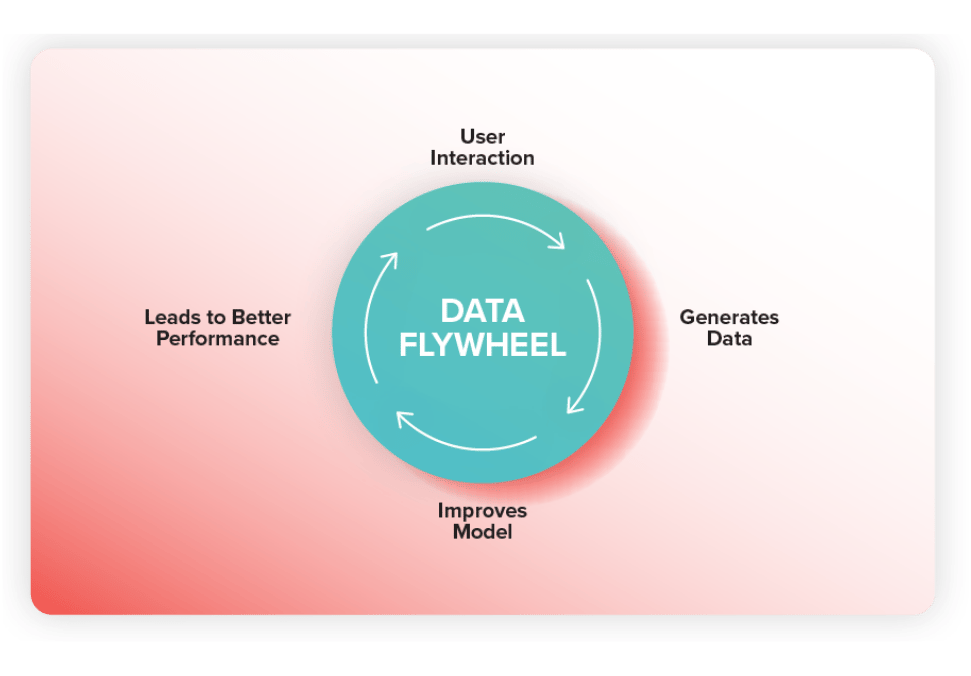
Competitive advantage can no longer rely on product features alone. Companies must build a sustainable barrier that protects them from competitors and the rapidly evolving AI landscape. These durable, defensible moats are strengthened by several factors, but one of the most critical is the creation of proprietary data flywheels. These are self-reinforcing systems where user activity generates unique data that improves the AI model, enhances the product, and attracts more users. When combined with deep integration into customer workflows, trust earned through transparent and explainable AI, and the strategic use of regulation to establish barriers to entry, these elements together create a lasting and resilient competitive edge.
Authored by Lee Sanderson, Principal Software Craftsperson at Codurance, this white paper provides a strategic framework for private equity investors, operating partners, and portfolio leaders navigating the AI revolution. It outlines the new competitive dynamics introduced by AI, details strategies for building durable and defensible moats, and presents a redefined playbook for the PE investment lifecycle – from initial diligence through to post-investment value creation and exit.
As a global software consultancy specialising in helping private equity-backed businesses unlock and accelerate value through modern technology, Codurance works across the investment lifecycle to modernise legacy systems, enable AI readiness, and build high-performing engineering teams. By bridging the gap between high-level investment strategy and deep technical execution, we help firms mitigate risk and realise stronger returns at exit.
AI has fundamentally altered the barriers to entry and the pace of competition across numerous industries. The technology can act as a powerful democratising force, granting new entrants access to advanced capabilities that were once the exclusive domain of large, established players.
By leveraging AI to automate complex processes, generate sophisticated creative and analytical outputs, and deliver high-touch customer service at scale, new competitors can develop and launch rival products and services with unprecedented speed. This dynamic significantly shortens the window of defensibility for incumbents, who now face a compressed timeline to innovate before their core value proposition is replicated or rendered obsolete.
The highest risk of disruption is concentrated in verticals where AI can automate the routine, data-intensive, or creative tasks that form the core of the existing value proposition. This leads to commoditisation and severe, sustained EBITDA margin pressure.
Industries where scale, brand, or proprietary processes once created durable advantages are now especially vulnerable to AI-enabled disruption. This includes:
1. Professional Services
At risk: Legal, accounting, consulting, and investment research firms.
Why: AI automates high-value cognitive tasks (drafting, due diligence, compliance checks, forecasting) that historically justified premium pricing.
Impact: Significant EBITDA-at-risk as low-cost AI entrants erode the Lifetime Value (LTV) / Customer Acquisition Cost (CAC) ratio by offering comparable quality at a fraction of traditional pricing, leading to severe margin compression.
2. Financial Services & Asset Management
At risk: Traditional wealth management, credit analysis, and trading desks.
Why: AI-powered quantitative tools democratise analytics once reserved for large institutions.
Impact: Retail and mid-market players can now match institutional-grade insight and execution.
3. Healthcare & Diagnostics
At risk: Diagnostic imaging, pathology, and clinical trial management.
Why: AI models outperform or augment human experts in image interpretation and pattern
recognition.
Impact: Large healthcare incumbents face competition from lean, data-driven diagnostic startups.
4. Education & Training
At risk: Universities, corporate training, and test prep providers.
Why: AI-driven adaptive learning platforms and credentialing systems challenge traditional tuition-based models.
Impact: Erosion of brand-based moats founded on strong academic reputations and alumni networks, coupled with the growth of direct-to-consumer alternatives.
5. Creative Industries
At risk: Advertising agencies, media production houses, game studios.
Why: Generative AI can produce creative assets, copy, and even code at scale.
Impact: Talent leverage diminishes; smaller teams achieve enterprise-level output.
6. Software & SaaS
At risk: Vertical SaaS providers and B2B software vendors.
Why: AI copilots and open-source LLMs enable rapid replication of product features.
Impact: Feature differentiation becomes fleeting; pricing power erodes.
7. Customer Support & BPO
At risk: Offshore call centres and managed service providers.
Why: AI chatbots and voice agents deliver personalised support at lower cost.
Impact: Traditional labour arbitrage advantages evaporate, necessitating a shift toward outcome-based pricing to protect top-line revenue.
In addition, for a specific subset of SaaS businesses in the “AI-Adapter” category whose products are built upon or extend the functionality of major technology ecosystems (such as large-scale CRMs, cloud providers, or DevOps platforms) the primary threat is disintermediation by these platform incumbents. This occurs when the platform owner embeds “good enough” AI features directly into their core product, rendering the specialised third-party tool redundant.
Conversely, the strongest and most defensible opportunities emerge from deploying or investing in AI as a catalyst for driving the value creation plan.
1. AI-Enabled Rollups
As simple software features become commoditised, traditional moats based on functionality alone are eroding. The most durable and valuable moats in the age of AI are multifaceted, requiring a layered defence by combining proprietary data, deep technological integration, and a strong market position built on trust.
The Primacy of Proprietary Data
The apex of modern defensibility is the “data network effect”, or data flywheel. This is a virtuous cycle where a product’s use generates unique, proprietary data that no competitor can access. This data is then used to train and improve the underlying AI model. A better, smarter model leads to a superior product, which in turn attracts more users. These new users generate even more data, further accelerating the leader’s advantage and making the gap between them and their competitors increasingly difficult to close. This is the ultimate moat.
In high-stakes verticals such as finance, law, compliance, and healthcare, trust is a fragile prerequisite for adoption. A company that can offer explainable AI, providing a clear, auditable trail for why its AI made a specific recommendation, gains a powerful competitive advantage over opaque black box systems, which carry significant reputational and legal risk. Auditability is not a feature but a core requirement.
For companies facing existential threats from large, generalist platforms, the most viable defence is to become the undisputed expert in a specific vertical or workflow. This deep focus allows them to build features, models, and integrations trained on domain-specific terminology, regulations, and processes that broader, general-purpose AI systems are not optimised to interpret with the same level of precision.
The gap between leaders with a functioning data flywheel and laggards is becoming insurmountable. Are your portfolio companies building moats or just features? Codurance helps you design and implement the ‘Data-to-Product’ pipelines necessary to turn user interaction into a compounding competitive advantage.
An emerging and powerful moat is the strategic use of complex regulations. The increasing complexity of the regulatory landscape, particularly the EU AI Act, can be turned into a competitive advantage. Companies whose tools may be classified as “High-Risk” (e.g., in HR, finance, or critical infrastructure) can build a “compliance moat”. By proactively achieving and marketing adherence to these stringent standards, they create a significant barrier to entry for new or less-prepared competitors, turning a regulatory burden into a marketable asset.
This strategy, while not specific to AI, reflects a traditional but highly effective approach to building defensibility. When a product is deeply embedded into a customer’s critical and complex business processes, such as becoming the system of record for accounting, the core platform for logistics, or the central hub for HR, the cost, difficulty, and operational risk of replacing it become immense. This creates powerful customer lock-in and extremely high switching costs.
For SMEs with limited technical resources and smaller engineering teams, the decision to use third party AI or Large Language Model (LLM) services versus building solutions in-house involves balancing speed, cost, control, and risk.
For general-purpose LLM capabilities (summarisation, code generation, etc.), the clear strategic
path for SMEs is to leverage pre-trained foundation models. Competitive differentiation is achieved
by customising these models with proprietary data, primarily through two key approaches:
Example: A legal tech SME could integrate RAG with its contract database to provide tailored summaries or clause suggestions using an open-weight model.
Leveraging third-party APIs drastically shortens Time to Value (TTV) and shifts R&D requirements from heavy CapEx to predictable, scalable OpEx. SMEs can prototype and deploy features in weeks, not months. However, this agility comes with strategic trade-offs:
Vendor Lock-In: Relying heavily on a single AI provider (e.g., OpenAI, Anthropic, or Google) creates dependency risks. Pricing models may change, rate limits may tighten, or the provider could discontinue certain APIs.
Data Privacy and Compliance Risks: Using third-party APIs can raise concerns about how customer or proprietary data is transmitted, stored, and used. SMEs in regulated sectors must ensure compliance with standards such as GDPR or HIPAA.
Service Availability and Latency: Outages or service degradations from the provider can directly impact customer-facing applications, leading to operational downtime.
Abstract model integration behind an internal API layer so providers can be swapped with minimal disruption.
Adopt a multi-vendor strategy (e.g., supporting both OpenAI and Anthropic endpoints).
Use open-weight models where feasible for privacy-critical workloads.
Maintain local RAG pipelines so that proprietary data remains within the company’s control.
Cost, Control, and Long-Term Strategy
Short-Term: Third-party APIs are cost-effective for experimentation and MVPs.
Medium-Term: As usage scales, API costs can become significant, especially for inference-heavy applications. At that point, SMEs might consider self-hosting open-weight models for predictable costs and greater control.
Long-Term: A hybrid approach that uses commercial APIs for generic tasks and in-house fine tuned models or RAG for proprietary data often strikes the optimal balance between cost, agility, and risk management.
AI is not just a product feature; it is a profound tool for internal transformation and a catalyst for moving up the value chain.
As AI agents and automation take on more work, the value a platform delivers becomes increasingly independent of the number of human users. This shift undermines traditional per-seat pricing models. In addition, off-the-shelf AI models are typically priced by token, which is a pricing structure many infrastructure providers are not accustomed to. To remain sustainable, pricing strategies need to evolve toward models that better reflect value creation, such as consumption-based, hybrid, or outcome-aligned approaches.
AI has the potential to automate a significant portion of time spent on routine tasks, freeing employees for higher-value strategic work. Key areas include:
AI necessitates a new set of criteria for evaluating investments and a new, more sophisticated narrative for positioning companies at exit. Many of these patterns are already emerging in live transactions and portfolio transformations across the private equity market.
Diligence must now “look under the hood” to distinguish between genuine AI value and superficial “AI washing”.
Red Flags (Signals of Weakness):
Identifying these red flags requires more than a checklist; it requires a ‘Code-Level’ interrogation.
At Codurance, our due diligence process, involves deep-dive architectural reviews to ensure the AI isn’t just a facade, but a robust foundation for future growth.
Positive Indicators (Signals of Strength):
For strategic acquirers, the traditional “build versus buy” decision is increasingly tilting towards acquisition, driven by the need for speed, execution certainty, and access to specialised talent.
However, to command a premium valuation, a target must represent more than an “acqui-hire.” While an acqui-hire provides skilled personnel, a “Team + Data Engine” delivers a proven, production-grade capability that is already generating value from a proprietary dataset. The exit narrative should therefore emphasise the strength and defensibility of this data moat as the core differentiator.
To navigate this rapidly evolving landscape, private equity firms and their portfolio companies must take decisive yet measured actions. The rise of AI is not a passing technological trend; it is a structural shift that redefines value creation, risk management, and competitive differentiation across every stage of the investment lifecycle.
1) Champion the "Data-to-Product" Pipeline
Conduct portfolio-wide data audits to uncover under-utilised data assets. The goal is to move from treating data as a “cost-to-store” liability to managing it as a “revenue-to-generate” asset. This requires clear investment roadmaps that transform static datasets into dynamic, revenue-producing AI products or services.
For New Investors: Prioritise due diligence on data maturity and accessibility when assessing targets. A company with fragmented, low-quality, or inaccessible data is unlikely to realise AI driven value quickly.
For Recent Acquirers: Begin integrating and cleaning datasets early in the post-acquisition phase to lay the groundwork for data monetisation and cross-portfolio synergies.
For Near-Term Sellers: Develop tangible AI-driven use cases that demonstrate commercial traction. A working “data-to-product” engine can materially enhance valuation multiples and make the asset more attractive to strategic buyers.
2) Invest in Specialist Talent
An AI strategy is only as strong as the team executing it. The absence of specialist AI talent, such as data scientists, ML engineers, and AI product managers, signals a significant competitive risk. PE firms must either build these capabilities internally or ensure portfolio companies have access to them through partnerships, secondments, or targeted acquisitions.
For New Investors: Evaluate the depth of AI and data talent during due diligence as a predictor of innovation capacity and scalability. Consider factoring future talent acquisition costs into valuation models.
For Recent Acquirers: Implement talent retention and upskilling strategies immediately after the deal to prevent erosion of key technical expertise. Early identification of internal AI champions can accelerate cultural adoption.
For Near-Term Sellers: Strengthen teams with visible AI leadership and operational maturity. Demonstrating a functioning, well-resourced AI capability can reassure buyers of sustainable future growth.
3) Weaponise Governance and Regulation
AI governance, ethics, and explainability are no longer optional. Proactive compliance with emerging frameworks such as the EU AI Act should be viewed as a source of competitive advantage, not a regulatory burden. Turning necessary compliance into a commercial differentiator builds trust with both regulators and customers.
For New Investors: Assess the target’s exposure to AI-related regulatory risks and their readiness for compliance. Lack of governance frameworks can signal both operational immaturity and future liabilities.
For Recent Acquirers: Introduce portfolio-wide AI governance standards and ethics frameworks early. Centralised oversight across multiple assets can both mitigate risk and create operational consistency.
For Near-Term Sellers: Build an auditable trail of compliance and risk management practices. A demonstrably ethical and well-governed AI footprint can materially increase buyer confidence and shorten due diligence cycles.
4) Promote a Pragmatic Technology Strategy
AI deployment is capital-intensive. Portfolio companies must adopt a disciplined approach across the options of building, fine-tuning, or curating models, balancing speed, cost, and differentiation. The real value often lies not in building foundational models but in applying them effectively to a
company’s proprietary data and workflows.
For New Investors: Evaluate technology stacks for flexibility and interoperability. Over-reliance on proprietary ecosystems or costly third-party APIs can erode long-term margins.
For Recent Acquirers: Rationalise technology investments by focusing on the last-mile problem, embedding AI into the business’s unique operational context where it can deliver measurable ROI.
For Near-Term Sellers: Optimise the AI footprint for scalability and maintainability. A lean, well-
integrated AI architecture signals to buyers that future costs and technical risks are well managed.
AI is transforming the way value is created, captured, and assessed in private equity. By taking a strategic and stage-specific approach, PE firms can maximise returns and reduce risk across the investment lifecycle.
For new investments, rigorous evaluation of data assets, talent, and governance readiness ensures targets are positioned for rapid AI-driven value creation. For recent acquisitions, early integration of AI capabilities and disciplined technology strategies accelerate performance and unlock synergies. For assets approaching exit, demonstrating a well- governed, revenue-generating AI engine enhances attractiveness and valuation multiples. Across all stages, aligning investment decisions with the real sources of AI value, including data, people, and operational application, creates a durable competitive advantage that distinguishes forward- looking private equity firms in an increasingly AI-driven market.
This perspective is grounded in Codurance’s work with private equity firms and investment-backed businesses across the full investment lifecycle. We support investors and boards in understanding technology risk at diligence, shaping AI-led value creation plans post-investment, and building credible, defensible technology narratives at exit.
As a global software engineering consultancy rooted in software craftsmanship, Codurance combines deep engineering expertise with a pragmatic understanding of how data, platforms, and AI translate into enterprise value. Our work focuses not on AI as a feature, but on embedding it safely and effectively into core products, operations, and decision-making – where it can compound advantage, reduce risk, and withstand scrutiny from future buyers.
Lee Sanderson has over 30 years of experience in software development, spanning roles from Developer to hands-on CTO, and is a polyglot programmer with deep experience across modern technologies. He enjoys helping teams move faster by streamlining development through XP, Agile practices, and continuous delivery, while maintaining clean architecture and high-quality code. He also enjoys spending time exploring how AI will shape the future of software engineering.
Talk to Codurance about Technical Due
Diligence, Value Creation, AI Readiness
and Exit Preparation aligned to your
technology strategy.